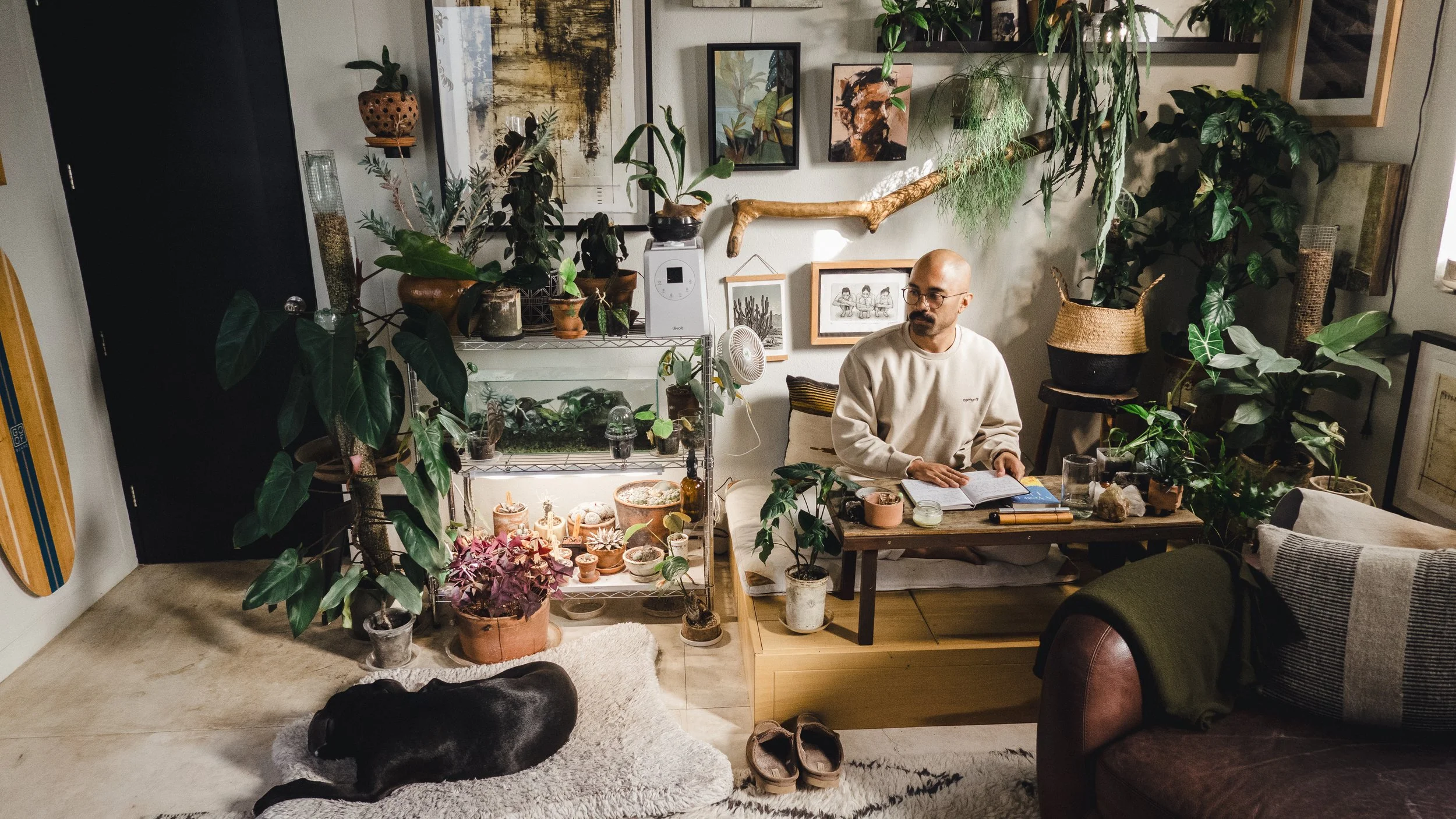
It is 5:50 on a Saturday morning. I have been awake for about an hour. I just finished a 42-minute meditation and spent some time journaling. Remnants of sage are still in the air. Above me, the heater is lightly pushing out warm air, and three candles are burning in front of me.
During meditation, a new value emerged. Or maybe it was not new. Maybe I finally became quiet enough to recognize what had already been organizing my life.
In the past, I would have named my core values in this order: health and energy, connection, then financial stability or financial safety. But this morning, something rearranged itself. I realized that my number one value in this phase of my life is slow living.
I do not mean a life without goals, responsibility, or movement. I mean a life with enough space to feel the life I am living. A pace with rest inside it. A way of moving through the day that does not require my body to brace against the day.
If you have been wondering how to slow down in life, perhaps the question is not only how to do less. Perhaps it is how to move at a speed your body can remain present for.
This reflection began as one of my Living Letters, a place where I speak from what I am noticing before I have polished it into certainty. Slow living is one of those truths I am still living into.
A Life Can Be Beautiful and Still Move Too Fast
Before we moved, our life in Oakland and the Bay Area was incredible. It was fun. We had stable jobs and a full community. There were events, friendships, activism, and so many opportunities to participate. We were surrounded by go-getters, people who cared deeply and wanted to make things happen. We were caught up in that speed too.
I do not look back at that life as wrong. Sometimes we only understand the cost of a pace after stepping outside of it, and the cost does not erase the beauty.
What I did not know then was that another way of living was possible. After we moved, I began to experience a pace with more room in it. There was time. There was rest. There were moments when I did not feel that something had to happen immediately. I discovered that I flow better in a life that allows effort and restoration to belong together.
Slow living, for me, is partly the absence of unnecessary urgency. It is not the absence of pressure, because every life has pressure. It is not permanent calm, because bodies move through activation, settling, joy, grief, frustration, and desire. It is the capacity to notice when I am accelerating and ask whether the moment actually requires it.
Many of us associate speed with care. We answer quickly to be dependable, keep producing to feel secure, and hurry toward the next goal because pausing might expose uncertainty. These patterns may have helped us belong, survive, or stay ahead of consequences.
The invitation is not to shame the part of you that knows how to move fast. It is to help that part learn that it does not have to drive every mile.
Slow Living Is Not the Opposite of Ambition
Over the years, slow living has quietly entered many parts of my life. My coaching business is one of them. I am about ten years into this work, and it has been a slow build. I am still building.
I did not force myself to reach a certain number of followers, collect email addresses quickly, or push out content at a pace that emptied me. I have tried to grow at a speed that supports my well-being and the balance of my life.
Slow growth is not always comfortable, especially when I watch someone else appear to move faster. Still, I return to one measure: Can I stay connected to myself while I build?
My plants have become teachers in this. If you have seen my office, you know how much I love plants and gardening. Tending and waiting take time. Some of my Ariocarpus cacti may take around ten years to mature and bloom. I cannot motivate them into flowering sooner.
I can create supportive conditions. I can pay attention. I can care for what is alive, and then I have to let time participate.
The plant is not behind because it has not bloomed. Its pace is part of its nature. Caring for it lets me witness development that cannot be rushed.
I have been learning something similar through my body. For roughly three years, I have been working toward greater strength and fitness. I am in good shape, but my body does not look the way it did at 26 or 27, when I was almost bodybuilder-like. Now I am slowly increasing the weight I can handle, my sprinting speed, and how long I can train.
Slow living lets me hold aspiration and acceptance together. I can want to become stronger without treating my present body as a problem. I can work toward change without withholding respect until I arrive. Acceptance is not resignation. Sometimes it is the ground that makes sustainable change possible.
What Constant Urgency Can Do to the Body and Our Relationships
Chaos is a harsh word, but many people live near it. We may be surrounded by people, workplaces, or circumstances that treat everything as urgent. At other times, nothing outside us demands immediate action, but something inside keeps saying, Hurry. Do more. Do not stop.
The stress response is not the enemy. Fight, flight, and freeze are protective, not character defects. The difficulty comes when activation becomes so frequent or prolonged that the body has little opportunity to recover.
The National Institute of Mental Health distinguishes stress, often a response to an external cause, from anxiety, which can continue without a current threat. Both can affect sleep, tension, pain, and other aspects of health. Not every busy season is dangerous, but our bodies register the conditions we repeatedly live inside.
Researchers use the term allostatic load for the cumulative burden associated with chronic stress and repeated adaptation. A systematic review of allostatic load research found associations between greater allostatic load and poorer physical and mental health outcomes. The body is adaptive, but adaptation still uses energy.
This is why I think about the tiger or bear metaphor. A deadline is not literally chasing us, but the body can still mobilize around a perceived threat to security, identity, belonging, or the future. The jaw tightens. The breath becomes shallow. We speak more quickly and listen less fully, our foot on the gas with no clear place to arrive.
Rest does not magically cure everything, and healing is not limited to calm. It may include movement, grief, conflict, therapy, medical care, community, and doing something once felt impossible. Still, restoration needs conditions. When we are not continuously mobilizing, the body has more opportunity to sleep, digest, repair, integrate, and reconnect.
Our pace does not remain private. When I am rushing, people around me may feel hurried too. They may sense there is not enough time for their full answer, emotion, uncertainty, or rhythm. My urgency can communicate, We need to get through this, when the other person needs to feel met.
Research does not tell the whole story. In a daily-diary study of married couples, greater daily stress was associated with more same-day conflict, especially when both partners reported high stress. The study examined a specific population, not every relationship. Still, it reflects something many of us know: stress can spill across the space between people.
This is not another reason to blame yourself. It is a reason to become curious. Perhaps slowing down is not only something you do for your health. Perhaps it is one way you create more steadiness for the people who share a life, room, team, friendship, or conversation with you.
How to Slow Down Without Abandoning Your Life
Slow living can sound like a luxury for people who can leave a job, move somewhere quieter, or clear their calendars. People live with caregiving, financial pressure, discrimination, illness, unpredictable work, and responsibilities they cannot remove. A slower life is not equally accessible to everyone, and pretending otherwise can turn compassion into another standard people fail to meet.
You do not have to transform your whole life this weekend. You might begin by reducing the speed of one ordinary action.
Choose one place to move five percent slower
This morning, I wrote more slowly in my journal. It felt good, and I could actually read my handwriting. That small shift did not solve my life. It changed the quality of my contact with one moment.
You might speak slower and feel the words before they leave your mouth. You might walk slowly enough for your eyes to register where you are. You might pause before answering a message or take one breath that is slower than the breath before it.
Research on slow breathing is promising, but should be held lightly. A systematic review and meta-analysis of voluntary slow breathing found changes in measures related to heart rate variability and autonomic regulation. Slower breathing will not feel right for everyone. If focusing on breath makes you anxious, dizzy, or disconnected, you can stop. Your body gets to inform.
The point is not to perform calm. The point is to introduce enough space that you can notice what is already happening.
Ask what the urgency is trying to protect
When you notice yourself rushing, you might ask: Is something actually urgent right now? What does my body expect will happen if I slow down? What becomes easier to feel when I keep moving?
There are no wrong answers. Maybe urgency helps you avoid disappointing someone or gives you a sense of control. Maybe slowing down brings up grief, loneliness, fatigue, or fear of falling behind. The rushing is not proof that you are broken. It may be carrying something important.
We do not have to rip that strategy away. We can release the gas for a few seconds, then a few minutes, then perhaps one protected part of the week. A sustainable pace is built through repeated experiences of enough safety, not one dramatic decision to become different.
A Pace Your Body Can Stay In
I keep thinking about the three candles in front of me and the heater moving air above my head. Nothing dramatic happened in that room. I sat. I breathed. I wrote slowly enough to read my own words. In that spaciousness, something true became easier to hear.
Slow living is not a finish line I have reached. It is a value I can use to orient. When I consider a new goal, commitment, or opportunity, I can ask whether the pace allows me to stay in relationship with my health, the people I love, and the life already happening around me. I can ask whether there is room for recovery, surprise, and time.
Like caring for a cactus that may take a decade to bloom, this way of living asks for trust. Not passive trust. Participatory trust. I still water, tend, train, work, build, and make choices. I just do not want force to be the only way I know how to grow.
Maybe your life cannot become slower all at once. Let that be enough for now. Notice one place where urgency has become automatic. Feel what happens in your jaw, chest, belly, hands, or breath when you imagine moving five percent slower. You do not have to make your body relax. Just notice what it says.
This reflection is for people of every gender. My private practice is specifically for men, and I work with cis, gay, bi, trans, and queer men carrying many different histories and ways of moving through the world. If urgency, shutdown, or chronic stress has become difficult to shift alone, you are invited to explore somatic coaching for men. We can begin by listening for a pace that supports change without asking you to abandon yourself to achieve it.